 Pendlefinance
 yield trading with V2 spot and Boros margin
Pendlefinance separates an asset's principal from its future yield in V2 and supports leveraged funding-rate trading through Boros. Principal Tokens (PT) offer a maturity-linked redemption value, while Yield Tokens (YT) receive the asset's yield until expiry. V2 also supports liquidity provision and trading before maturity. Boros exchanges fixed and floating funding payments through collateralized positions. Choosing between them starts with the exposure you want: principal redemption, future yield, pool returns, or changes in funding rates.
last updated
A fixed return through V2 principal tokens
Holding a discounted principal token until maturity fixes the return in its accounting asset, provided the underlying redemption conditions hold. PT separates the principal claim from the variable yield that the asset generates. Its purchase price can sit below its expected redemption value because the yield belongs to YT. The difference establishes the fixed annual percentage yield (APY). That annualized rate also depends on the time remaining until the market matures.
A fixed return in an accounting asset doesn't fix that asset's price in another currency.
PT remains tradable before maturity. An early sale uses the available market price, which responds to yield expectations and liquidity. The eventual maturity value doesn't establish the proceeds from that sale.
Each maturity has its own market. Even when the underlying asset matches, different expiry dates can carry different implied yields. Choosing a maturity sets when PT becomes fully redeemable.
SY connects the asset to PT and YT
Standardized Yield (SY) wraps a yield-bearing asset so that Pendle's contracts can handle its yield mechanism through a common interface. The protocol mints PT and YT from SY, and its automated market maker (AMM) trades PT against SY. Supported conversions can happen within the application, so a user doesn't always need to handle the wrapper separately.
Different ways to obtain exposure
Minting both components
Depositing a supported yield-bearing asset can create the principal and yield components together. A supported base-asset deposit can also undergo conversion into the yield-bearing asset before minting. The conversion and the split have distinct functions, even when the application combines them.
Buying one component
Buying PT or YT separately acquires the selected exposure through trading. It doesn't require keeping both components.
The accounting asset
The asset shown in brackets in a market name identifies its accounting unit. Redemption value follows that unit; the wrapped token can have a different exchange rate. SY wrapping also has exceptions to a one-to-one ratio, so token counts alone don't establish equal asset values.
What does the PT discount mean for a return?
The discount determines the gross difference between the purchase cost and maturity redemption, before fees and any underlying-asset loss.
In this hypothetical quote, one PT-wstETH (stETH) costs 0.937 stETH, and the position stays open until maturity. Under normal redemption conditions, its expected maturity value equals 1 stETH. Subtracting 0.937 from 1 gives a gross gain of 0.063 stETH. That's approximately 6.72% of the purchase cost.
The 0.063 stETH difference represents the gain; the 1 stETH redemption includes the committed capital. This percentage describes the holding period. Calculating an annualized rate would also require the remaining time to maturity.
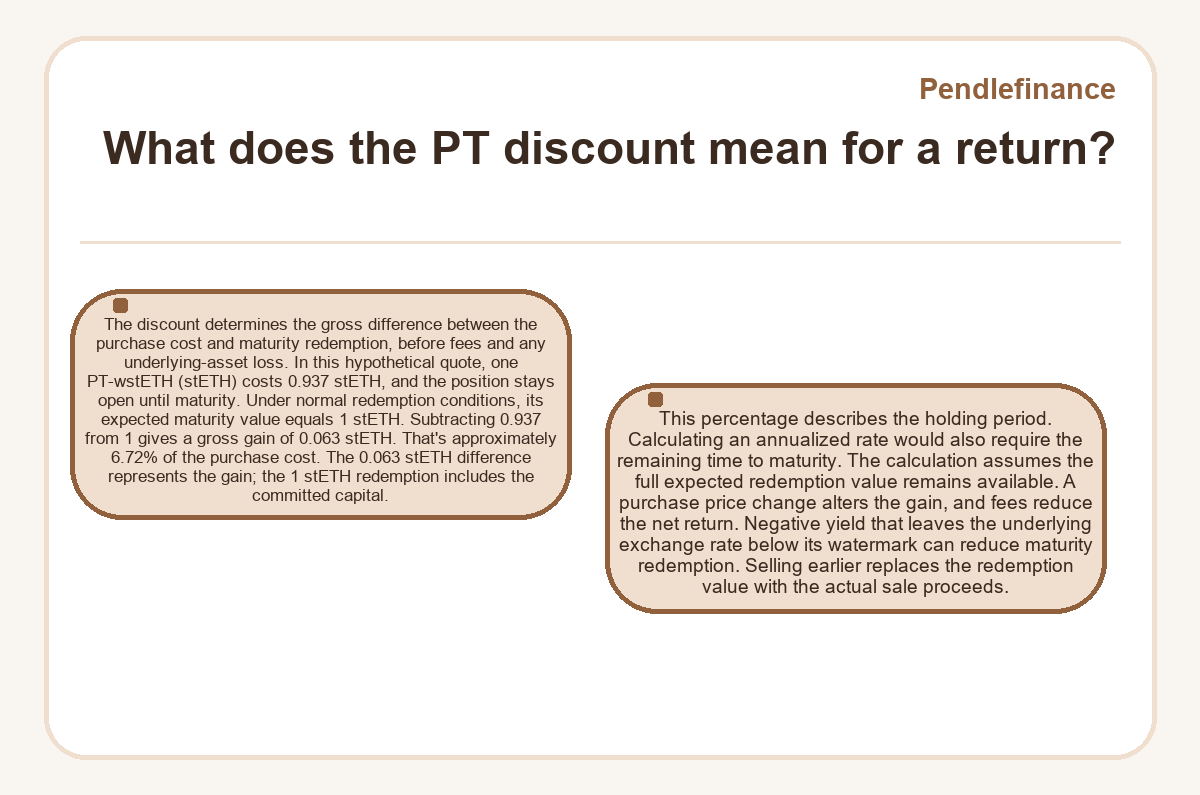
The calculation assumes the full expected redemption value remains available. A purchase price change alters the gain, and fees reduce the net return. Negative yield that leaves the underlying exchange rate below its watermark can reduce maturity redemption. Selling earlier replaces the redemption value with the actual sale proceeds.
Can a YT position lose its entire purchase cost?
A YT position can lose its entire purchase cost if it earns no yield before its token value reaches zero at maturity. YT entitles holders to the asset's yield and any points it generates until maturity. It doesn't include the principal redemption claim. Its lower purchase cost relative to the underlying asset creates leveraged yield exposure, without a margin loan inside the fully purchased V2 position.
Underlying APY generally represents a seven-day moving average of the asset's yield. Implied APY reflects the future yield priced by the market. A recent underlying rate doesn't establish what the asset will earn through the remaining term. The yield actually collected must exceed acquisition costs and applicable fees for a held-to-maturity YT position to profit.
Long Yield APY estimates annualized YT returns assuming the current underlying APY stays constant. That estimate can be negative.
As expiry approaches, less time remains to generate yield. With unchanged implied yield, YT's price declines toward zero. Already accrued yield remains claimable. If the underlying exchange rate falls below its watermark, further yield accrual pauses until that rate recovers to the watermark.
A shared pool for trading and liquidity
V2's AMM concentrates liquidity within a configured implied-yield range and tightens its curve as maturity approaches. Its PT/SY pool supports PT trading directly and YT trading through flash swaps. Liquidity-provider (LP) tokens represent shares of that pool. Returns can include PT appreciation, yield from SY, swap fees, and allocated PENDLE incentives. The mix changes with the position and market. At a configured yield-range boundary, thin liquidity can prevent further trading in that direction. An early LP exit remains sensitive to yield changes and available liquidity.
Fees, order execution, and an early exit
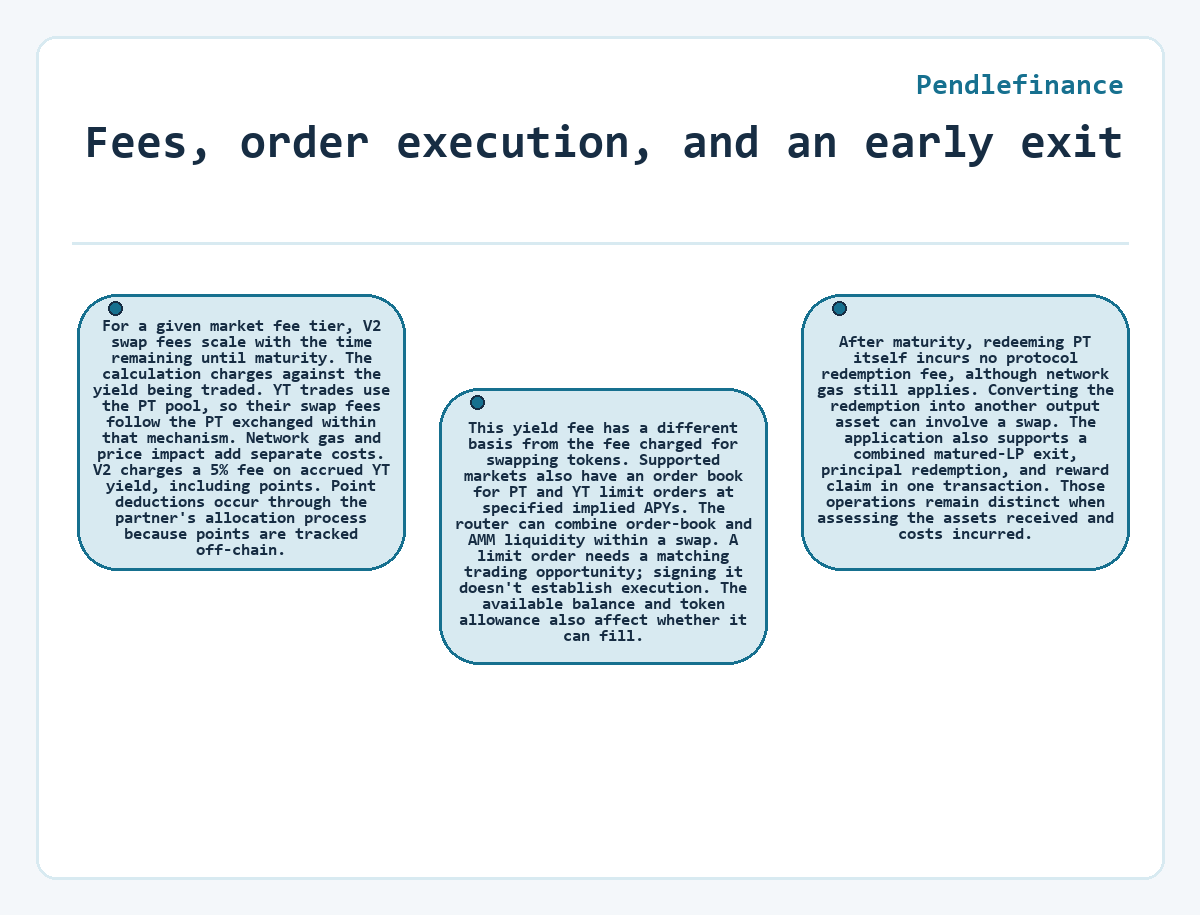
For a given market fee tier, V2 swap fees scale with the time remaining until maturity. The calculation charges against the yield being traded. YT trades use the PT pool, so their swap fees follow the PT exchanged within that mechanism. Network gas and price impact add separate costs.
V2 charges a 5% fee on accrued YT yield, including points. Point deductions occur through the partner's allocation process because points are tracked off-chain. This yield fee has a different basis from the fee charged for swapping tokens.
Supported markets also have an order book for PT and YT limit orders at specified implied APYs. The router can combine order-book and AMM liquidity within a swap. A limit order needs a matching trading opportunity; signing it doesn't establish execution. The available balance and token allowance also affect whether it can fill.
After maturity, redeeming PT itself incurs no protocol redemption fee, although network gas still applies. Converting the redemption into another output asset can involve a swap. The application also supports a combined matured-LP exit, principal redemption, and reward claim in one transaction. Those operations remain distinct when assessing the assets received and costs incurred.
Boros trades fixed and floating funding rates
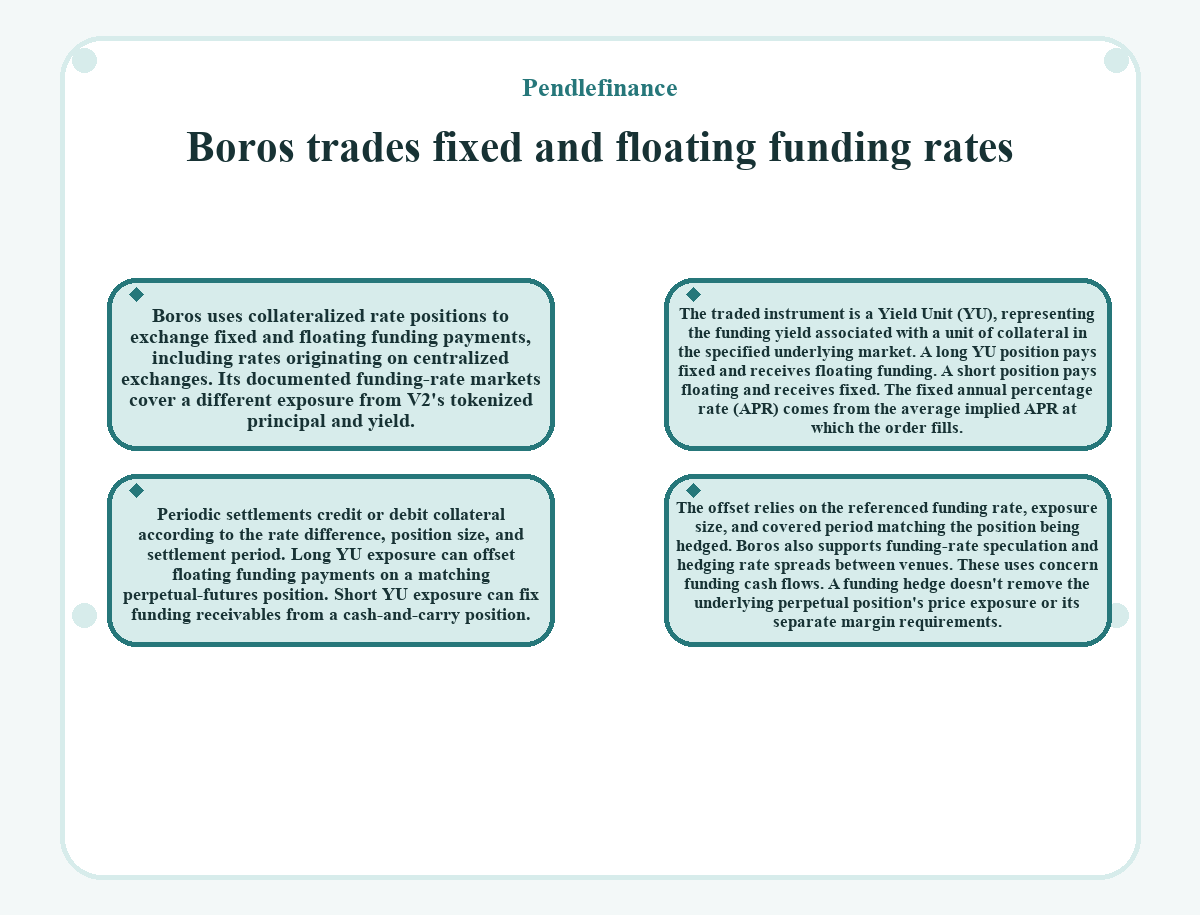
Boros uses collateralized rate positions to exchange fixed and floating funding payments, including rates originating on centralized exchanges. Its documented funding-rate markets cover a different exposure from V2's tokenized principal and yield. The traded instrument is a Yield Unit (YU), representing the funding yield associated with a unit of collateral in the specified underlying market.
A long YU position pays fixed and receives floating funding. A short position pays floating and receives fixed. The fixed annual percentage rate (APR) comes from the average implied APR at which the order fills. Periodic settlements credit or debit collateral according to the rate difference, position size, and settlement period.
Long YU exposure can offset floating funding payments on a matching perpetual-futures position. Short YU exposure can fix funding receivables from a cash-and-carry position. The offset relies on the referenced funding rate, exposure size, and covered period matching the position being hedged.
Boros also supports funding-rate speculation and hedging rate spreads between venues. These uses concern funding cash flows. A funding hedge doesn't remove the underlying perpetual position's price exposure or its separate margin requirements.
The risks that change the choice of position
A fully purchased V2 spot token has no margin liquidation, whereas a Boros position can become liquidatable when net balance falls below maintenance margin. Net balance includes collateral and unrealized profit or loss. Adverse settlements can erode collateral even if the mark rate doesn't change. Maturity therefore doesn't protect a leveraged position from liquidation before expiry.
For V2, the underlying asset's exchange rate and redemption mechanism remain relevant to PT, YT, and liquidity positions. Exploits in third-party contracts that V2 interacts with can also cause losses. A watermark records the highest observed exchange rate against the accounting asset. A decline below that level can impair principal redemption and interrupt yield accrual. An artificially elevated watermark can also delay resumed accrual.
The next choice is the exposure to hold and its time horizon. Principal redemption, future yield, liquidity provision, and funding-rate hedging have different costs and conditions. In Boros, that choice also includes the collateral needed to sustain the position through adverse rate movements.
Pendlefinance: common questions
Is PENDLE the token that redeems into a market's principal?
PENDLE is distinct from the Principal Token associated with an individual yield market. PENDLE can appear as an incentive earned by liquidity providers. PT carries the principal redemption claim for a particular underlying asset and maturity. Owning PENDLE doesn't grant that market-specific claim, and holding PT doesn't automatically earn the PENDLE incentives allocated to liquidity positions.
When can accrued YT yield be claimed?
Accrued YT yield can be claimed before maturity through the dashboard. Yield distributions arrive as SY, which can be unwrapped into the underlying asset using the applicable conversion. Maturity ends further accrual, while previously earned yield remains claimable. The ability to claim that balance doesn't give an expired YT a new principal redemption value.
What makes an existing V2 limit order only partially fillable?
An existing V2 limit order becomes only partially fillable when the wallet balance or token allowance remains positive but falls below the order amount. A zero balance or zero allowance makes the order invalid. Execution still requires a matching trade at the order's specified implied APY.
Does an LP wrapper change the size of the underlying pool share?
An LP wrapper represents the underlying liquidity position on a one-to-one basis. It is an ERC-20 token that enables the wrapped position to serve as collateral in compatible external money markets while preserving associated rewards, including PENDLE rewards and off-chain points. The wrapper retains exposure to the underlying pool; external collateral use introduces the borrowing market's own conditions.
Will a matured PT or LP position keep earning yield for its holder?
Yield generated by an unredeemed PT or LP position after maturity is redirected to the protocol's treasury fee wallet. The underlying asset can remain in SY and continue producing yield and points, but those new post-maturity accruals no longer belong to the position holder. Principal redemption and previously earned rewards are separate from those redirected amounts.
Where does Boros obtain the funding rate used in settlement?
Boros obtains the underlying funding rate through an oracle process that reads the referenced exchange or perpetual market. Settlement uses that underlying rate independently of Boros's order-book pricing. The order book establishes the traded implied rate, while the floating funding rate determines the other side of the settlement. Mark APR separately supports unrealized profit-or-loss and liquidation calculations.