 Pendlefinance
 first trade: when margin is required
Pendlefinance requires collateral for a Boros funding-rate position; buying PT or YT outright in V2 doesn't create a margin position. The first choice is between owning a yield-related token and exchanging fixed and floating funding payments. Boros also requires enough net balance to maintain the position's required margin.
last updated
Choose the market before committing funds
Choose the token or funding stream, its maturity, and the required input before authorizing your first trade. A missing funding asset can stop either purchase or position opening. Reviewing the terms before submission gives you a place to pause without starting the intended market exposure.
A V2 purchase exchanges an accepted input asset for PT or YT. Opening Boros exposure uses collateral to support a long or short rate position. Compare the same essentials for both actions: the exposure, maturity, funding asset, and execution terms. If you don't have the selected Boros market's collateral asset, stop before opening that position.
- For V2, identify the Principal Token (PT) or Yield Token (YT), the accounting asset, and the maturity.
- For Boros, identify the funding-rate market, its collateral asset, its maturity, and the long or short direction.
- Review V2's quoted input and token output alongside Boros's implied annual percentage rate (APR), position size, and initial margin.
- Leave the trade unsubmitted if the required input asset or trading collateral is missing.
- Review changed execution terms again before committing, including a revised quote or margin requirement.
The increase in the selected PT or YT balance after a completed V2 swap shows the quantity acquired. A Boros position's filled size and fixed APR show the opened rate exposure. Those observations confirm the opening action without proving later income. Collateral remains a requirement for Boros even when its live margin amount or quote changes.
Is margin required for every first trade?
Boros requires collateral for every position, while an outright V2 token purchase uses the assets that you spend on it. Holding PT or YT directly doesn't introduce Boros's maintenance-margin requirement. Any separate borrowing arrangement has its own collateral rules, even if the borrowed funds later buy V2 tokens.
YT still gives leveraged exposure to yield because its purchase price represents only the future yield component. That leverage comes from buying the yield claim at a fraction of the underlying asset's price. The token can lose value or produce insufficient income without a margin liquidation.
Initial margin sets the opening requirement
Boros calculates initial margin from the chosen position's notional size, remaining term, mark APR, and market risk parameters. Notional size describes the underlying asset quantity whose yield the position references. It doesn't describe the collateral that you deposit. A rate position can therefore reference substantially more underlying exposure than its posted collateral. The selected market and proposed position supply those inputs; there isn't a single opening amount for every Boros trade.
The detailed margin model multiplies absolute notional size by the market's initial-margin factor and two floored inputs. The time input is the greater of years to maturity and the time floor, expressed in years. The rate input is the greater of absolute mark APR and the rate floor. A lower absolute mark APR doesn't eliminate the collateral requirement. The initial-margin factor also changes how much capital the same rate exposure requires.
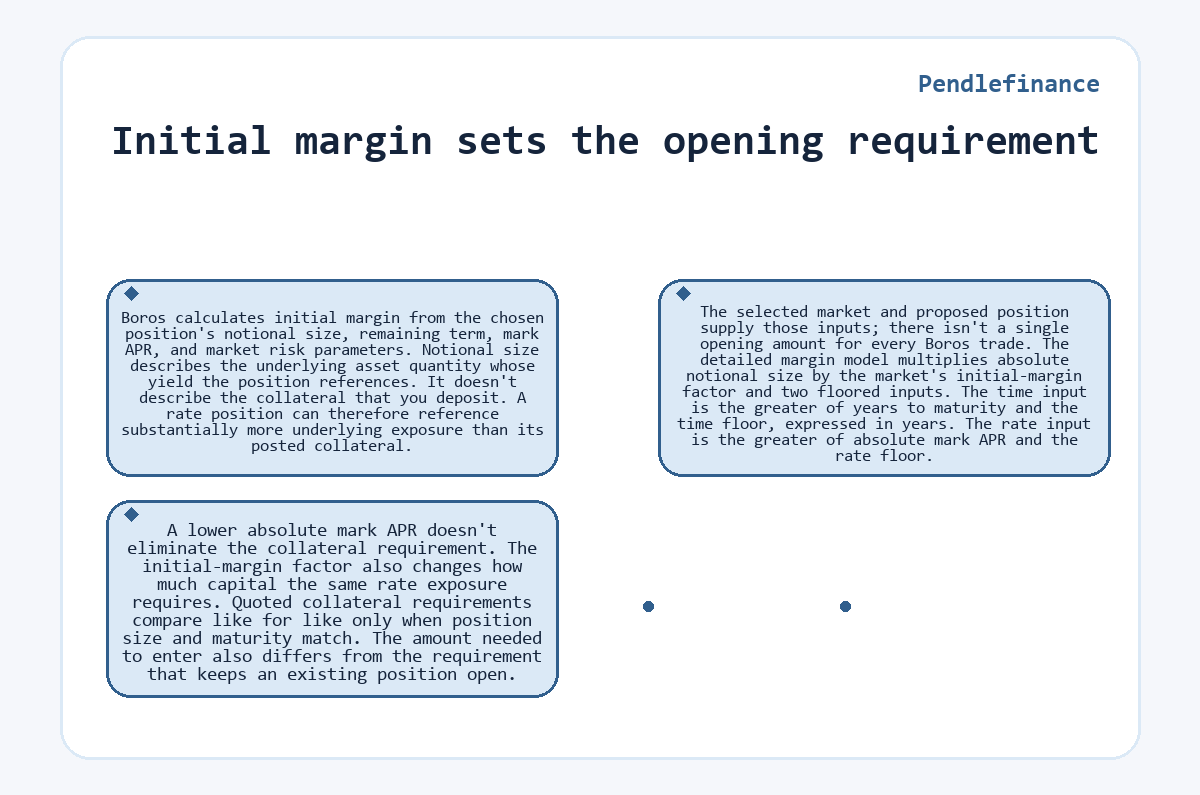
Quoted collateral requirements compare like for like only when position size and maturity match. The amount needed to enter also differs from the requirement that keeps an existing position open.
Keeping a Boros position above maintenance margin
Net balance combines collateral with unrealized profit or loss, so deposited capital alone doesn't determine a Boros position's margin status. A Boros position becomes eligible for liquidation when its net balance falls below maintenance margin. Boros's glossary describes maintenance margin as 66% of initial margin, while the detailed margin rules use separate market-specific factors. Use the selected market's margin parameters for its applicable requirement. Adverse market valuation can reduce net balance before the next funding settlement.
The mark APR drives unrealized valuation and liquidation calculations. Boros derives that mark from a time-weighted average of traded implied APR on its order book. This differs from the underlying funding rate that determines periodic cash flows. A position can therefore face changing margin pressure through valuation while its fixed execution rate stays unchanged.
Direction determines the funding payments
Long Boros positions pay fixed funding and receive floating funding; shorts reverse those streams. Direction expresses a funding-rate view, independently of the underlying token's spot price.
Long YU: Pay fixed, receive floating
Long Yield Unit (YU) positions receive the underlying rate and pay a fixed APR averaged across their fills. The settlement differential favors the long when floating funding exceeds that fixed rate. A matching long YU position can offset floating funding payments on an existing perpetual position, subject to the referenced funding stream and exposure.
Short YU: Pay floating, receive fixed
Short YU positions receive their fixed rate and pay the underlying floating rate. Their settlement differential favors the short when floating funding stays below the fixed rate. Pairing that exposure with matching floating funding receipts can fix the rate component of those receipts. Both directions retain Boros's collateral and liquidation requirements.
Settlements change collateral before maturity
Boros realizes the difference between fixed and floating funding into collateral whenever the underlying market settles its funding payments. Boros's Binance markets settle every eight hours, and its Hyperliquid markets settle every hour. These intervals belong to their respective funding streams. They don't describe a universal schedule for every market or the timing of an order fill.
Positive settlement amounts increase collateral, and negative amounts reduce it. Repeated adverse settlements can erode collateral even when the mark APR doesn't move. Margin requirements generally decline as the remaining yield stream shrinks toward maturity, but that decline doesn't cancel settlement losses. At maturity, rate sensitivity reaches zero and the position's margin is freed. The remaining collateral reflects the cumulative net settlements throughout the position's life.
V2's quote sets a different opening cost
A V2 token swap exchanges assets at an execution price that includes the market's trading conditions and applicable swap fee. The router can draw liquidity from the automated market maker (AMM) and supported limit orders. Available liquidity affects price impact and the number of tokens that the input buys.
V2's swap fee scales with time remaining until maturity and the pool's fee tier. With the other inputs unchanged, a shorter remaining term reduces the fee attributable to traded yield. The tier belongs to the selected market. Network gas adds a separate transaction cost, and any conversion route needs its own quoted output. Those entry costs don't establish the collateral requirement for a Boros position. PT redemption into the underlying yield-bearing asset after maturity has no protocol fee; network gas still applies.
A signed V2 limit order can remain unfilled
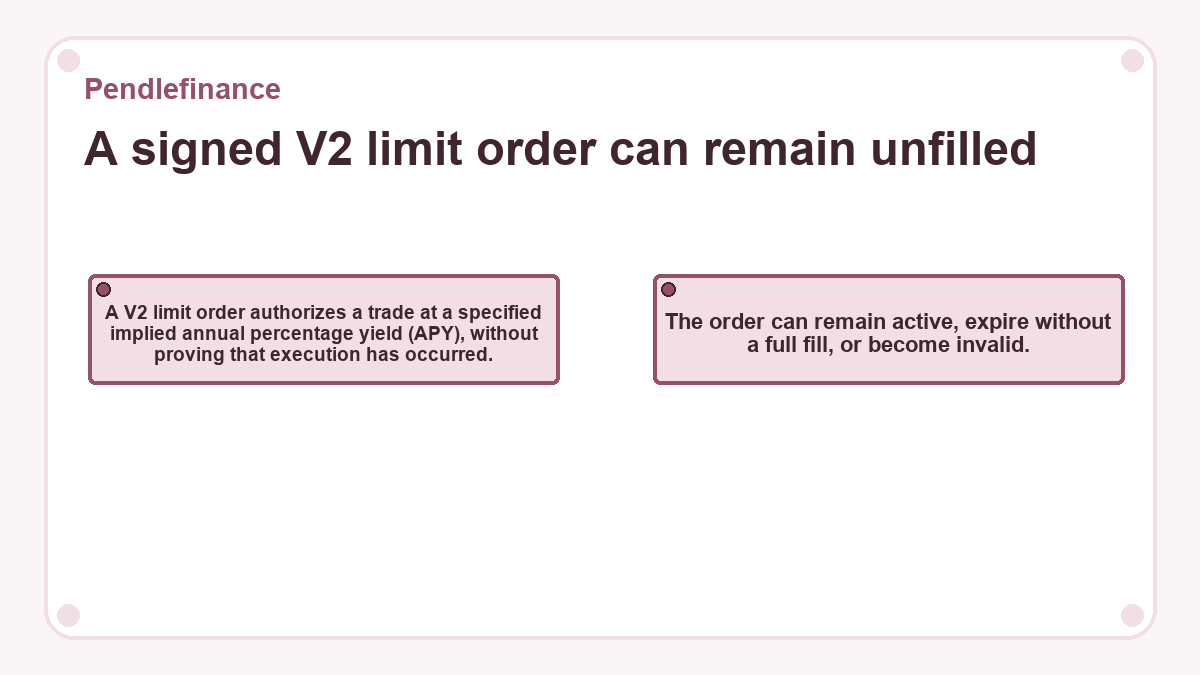
A V2 limit order authorizes a trade at a specified implied annual percentage yield (APY), without proving that execution has occurred. The order can remain active, expire without a full fill, or become invalid.
The asset that supports the order
V2's limit-order contracts support buys with SY or a deposit token accepted by the relevant SY; sell orders use PT or YT. An accepted input for a routed swap doesn't automatically qualify for this order type. Wallet balance and token allowance govern whether the order remains fillable. A signature doesn't substitute for either requirement.
Execution and expiry
The router can combine matching limit orders with AMM liquidity. Matching trades may fill an order partly or fully as trading reaches its chosen implied APY. An executed status means the order has filled completely. An expired status means expiry arrived before complete execution. A quoted rate or active order alone doesn't establish the final purchased quantity.
Revocation after signing
V2's limit-order contracts support both off-chain signatures and on-chain pre-signing. Cancelling an order requires an on-chain transaction that invalidates it. Leaving the preview before signing or pre-signing avoids authorizing the order. A signed order needs attention even when it hasn't filled, because later matching trades can still execute it while it remains valid.
Maturity and the asset behind the claim
A PT purchase's expected redemption value refers to the accounting asset named in the market, subject to the underlying redemption conditions. The payout can arrive as an equivalent value of the yield-bearing asset, so those names aren't interchangeable. Negative yield can push the yield-bearing token's exchange rate below its watermark, the highest recorded rate against the accounting asset, and PT can redeem for less than its expected accounting-asset value if that gap persists at maturity. Before maturity, YT stops earning yield while that exchange rate remains below the watermark. At maturity, YT stops accruing yield and its token value reaches zero; previously earned yield remains claimable.
Yield labels that matter at entry
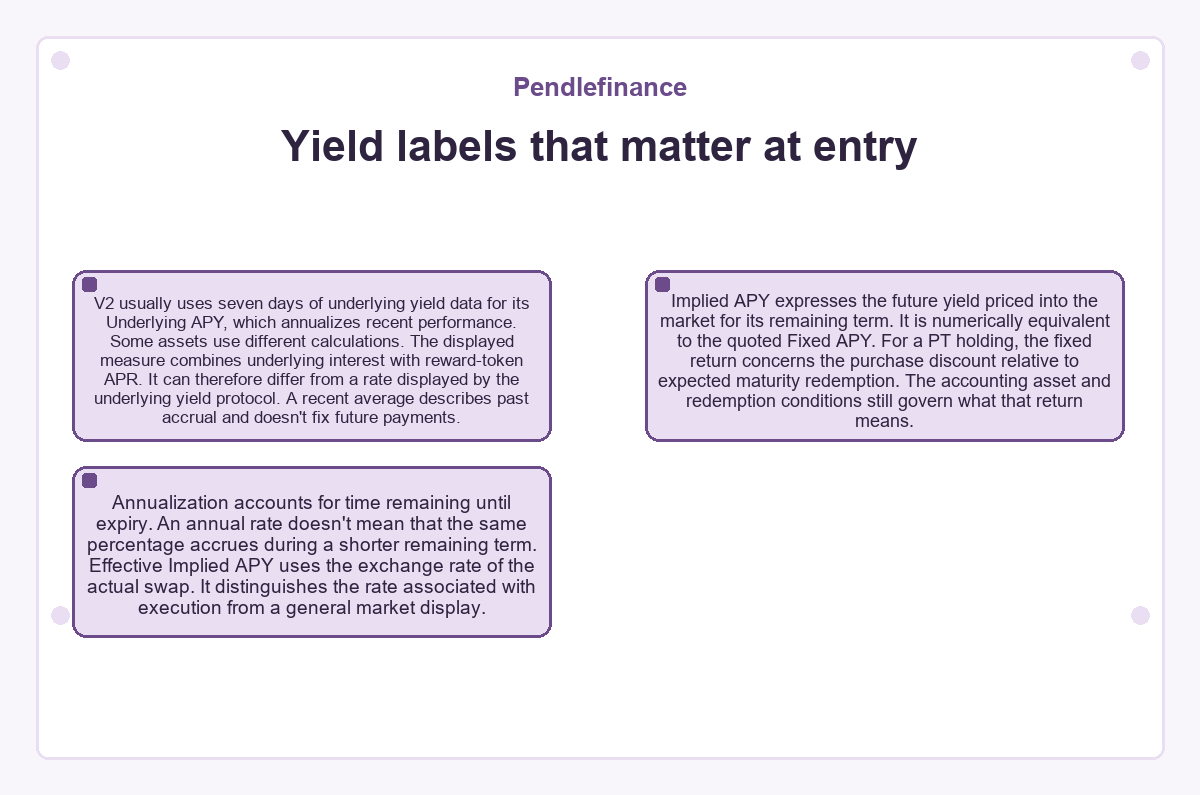
V2 usually uses seven days of underlying yield data for its Underlying APY, which annualizes recent performance. Some assets use different calculations. The displayed measure combines underlying interest with reward-token APR. It can therefore differ from a rate displayed by the underlying yield protocol. A recent average describes past accrual and doesn't fix future payments.
Implied APY expresses the future yield priced into the market for its remaining term. It is numerically equivalent to the quoted Fixed APY. For a PT holding, the fixed return concerns the purchase discount relative to expected maturity redemption. The accounting asset and redemption conditions still govern what that return means. Annualization accounts for time remaining until expiry. An annual rate doesn't mean that the same percentage accrues during a shorter remaining term.
Effective Implied APY uses the exchange rate of the actual swap. It distinguishes the rate associated with execution from a general market display.
Yield fees continue after the opening swap
A YT holder's ongoing yield fee adds a cost beyond the opening swap and network gas. It applies to accrued yield rather than the token's entire purchase price. Points also fall within that fee treatment, even though partner protocols track and allocate them off-chain. Those partners deduct the points fee during wallet allocation. For V2 YT, the yield fee is 5% of accrued yield, including points.
Everyday questions about Pendlefinance
Must I manually convert my token into SY for a Pendlefinance V2 purchase?
Supported V2 routes can handle yield-bearing-token wrapping and unwrapping without a separate manual conversion. Standardized Yield (SY) supplies the common contract interface behind that process. The available input and output still belong to the selected market and route. A supported automatic conversion doesn't make every wallet token acceptable for every operation.
Are points included in a first PT purchase?
PT holders forgo the variable yield and points that belong to the underlying asset's YT holders. Buying the principal claim therefore doesn't acquire those entitlements. Points-related exposure comes through the yield component, where the campaign's terms and applicable yield fee matter. A PT quote's fixed yield shouldn't be interpreted as including an additional points allocation.
What changes if I select another maturity for the same V2 asset?
A different maturity selects an independent market with its own implied yield. The same underlying asset can support multiple maturity dates, so its markets don't have interchangeable trading terms. Remaining time enters both the annualized purchase-rate calculation and the maturity-scaled swap fee. The first-trade quote needs to belong to the particular expiry that you intend to hold.
What assumption underlies the long Yield APY shown before a YT purchase?
Long Yield APY assumes that the underlying yield rate remains at its current level through expiry. It estimates an annualized return from the YT purchase price and projected yield after the applicable yield fee. The estimate can be negative when projected receipts are smaller than the purchase cost. Actual underlying yield can change during the holding period.
Will a Boros position hedge funding on a different perpetual market?
A Boros position references a specific underlying funding stream, so it won't necessarily offset another market's payments. Funding rates for the same asset can differ between exchanges. The relationship depends on the referenced market, position direction, and matched notional exposure. Pairing the positions also retains the collateral and liquidation requirements of each instrument.
Why might my small V2 limit order remain unfilled?
The router considers gas costs as well as price impact when allocating swaps to limit orders and the AMM. Using additional small orders can increase transaction costs, reducing their likelihood of filling, especially where gas is costly. Reaching a quoted implied APY therefore doesn't establish that every small order will execute. Wallet balance and allowance remain separate validity conditions.
How does remaining time affect the sensitivity of equally sized Boros positions?
More time to maturity increases rate sensitivity for equally sized Boros positions. The relationship multiplies notional size by days remaining divided by 365 and by 1% to measure exposure to a one-percentage-point APR change. A longer remaining yield stream therefore produces a larger valuation change for the same rate movement.
Is liquidity provision required before a first PT or YT purchase?
Buying PT or YT doesn't require opening your own liquidity-provider position. V2 trades use the market's existing liquidity, with YT trades able to route through its PT and SY pool. Depositing liquidity is a separate operation that creates a share of that pool. It introduces a different holding from simply purchasing one token component.